



When it comes to strength training, learning how to build muscle and see results that last can involve trial and error. Nailing down a routine that works is a process — and it may look different based on your body type and goals for strength and fitness. (Hint: There is no one-size-fits-all best muscle building program.)
That’s where we come in: We’re here to help you get crystal clear on the most efficient and effective routine for you. So, let’s explore some of the exercises that could be in your workout plan to build muscle mass, how to structure your routine, and vital insights like recovery and frequency to ensure your training takes you to new levels of strength.
Plus, we’ll reveal the one surefire way to make a workout plan that’s truly effective and leads to real results — stay tuned!
Make a workout plan with clear and attainable goals
The cornerstone of any successful venture is clear goal-setting. When you make a workout plan for strength training — or any health and fitness journey, for that matter — it’s about understanding what you want to achieve. For example, you might be looking to:
- Build bulk
- Be able to do 10 pull-ups
- Increase endurance in a specific muscle group
- Be able to lift your bodyweight
- Improve your squat form
- Burn fat and tone up
Setting SMART (Specific, Measurable, Achievable, Relevant, and Time-bound) goals not only gives you direction but also serves as a benchmark.
Related: The Best Muscle-Building Diet Guide to Fuel Your Growth
Stay committed for the long run
The most successful strength-training programs are those that you can do — and do consistently. You likely won’t be bench-pressing twice your bodyweight in one week, and that is OK! With each session, you’re one step closer to reaching your goals. Celebrate your victories, no matter how small they may seem, and use them to keep pushing forward.
To help you stay committed, remember that imperfection is expected and that missing one workout does not equal failure. This is where building a solid system that works for you comes in. On the days when motivation is low, you can rely on the plan you’ve already created instead of deciding day-to-day whether you want to go to the gym!
Use these three bonus tips to help stay on track:
- Follow a repeatable weekly schedule — going on the same days means fewer decisions.
- Track only the essentials: Weights lifted and reps completed, with a focus on intensity and volume.
- Focus on progress over perfection. That means “just show up” days count and sometimes 30 minutes is enough.
Related: 10 Ways to Stay on Track with Your Fitness Goals
Myth vs. fact: 5 misconceptions about building muscle
Before we get into the specifics of your workout plan, let’s dive into (and debunk) a few misconceptions about building muscle:
Myth #1: “More workouts = more muscle.”
Fact: Overtraining without recovery actually stalls growth.
Myth #2: “I need to feel sore from every session.”
Fact: Muscle growth comes from progressive tension, not exhaustion.
Myth #3: “Light weight and high reps tone muscle.”
Fact: There’s no toning — just building or maintaining muscle.
Myth #4: “Cardio kills gains.”
Fact: Too much poorly timed cardio can interfere, but smart cardio supports recovery and conditioning. It can also help balance your strength training routine.
Myth #5: “Programs need to be complicated.”
Fact: The best plan is one you can repeat consistently for eight to 12 weeks or more and apply progressive overload across those weeks.
As we’ll cover, the key elements needed for tangible progress and results include structure, enough food (especially protein), patience, and progressive overload.
Key principle: Gain muscle sustainably with progressive overload
One essential concept in strength training is progressive overload. This means gradually increasing the stress placed on your muscles during exercise and is a foundational part of the training plan you’ll build from the outline below.
You’ll want to find ways to challenge your muscles as they adapt and grow stronger. This can be achieved by increasing the weight, reps, or sets over time.
You can think of progressive overload as giving your muscles a reason to work harder. This can mean adding five pounds per set, adding one or two reps per set, focusing on better control and time under tension, or more total volume.
Tip: Keep a training log to record your progress to track performance and maintain motivation as you see the improvements week by week.
Create a training routine for strength in 4 steps
When you build a workout plan, there are a few things to keep in mind. We’ll dig into all four of these throughout this blog:
- Essential exercises: The exercises that should be the backbone of your plan.
- Structure: Sets, reps, and rest periods.
- Schedule and frequency: How often and to work out and for how long.
- Rest and recovery: Understanding rest days and how many you should have
Bonus tip: Once you’ve established your routine, take stock of what’s working and make adjustments.
Now, let’s break down these four steps.
1. Essential exercises to build muscle
Creating a workout plan for strength is about layering your sessions with compound lifts (moves that hit multiple muscle groups at once), along with isolation movements (those that focus on a particular muscle).
Aim for compound lifts about 75% of the time, as these drive most muscle growth and allow for heavier loading. Compound lifts also train multiple muscles. The other 25% of the time, focus on isolation lifts. These add volume safely, improve symmetry, and target weak points.
Note: As a general guideline, train each muscle group once or twice per week, with 10-20 total sets per muscle each week. Because the glutes are larger muscles, they can often tolerate higher volume. The shoulders also need balance (e.g., front delts handle pushing movements, whereas rear delts handle pulling).
The following exercises can form the pillars of your training, but of course, don’t be afraid to mix it up every so often!
Lower-body exercises
Squats

Squats aren’t just about leg strength; they engage your core, back, and stabilizing muscles. This makes squats an excellent choice for a full-body workout. Variations like front squats, back squats, and overhead squats can keep your workout routine diverse.
Deadlifts
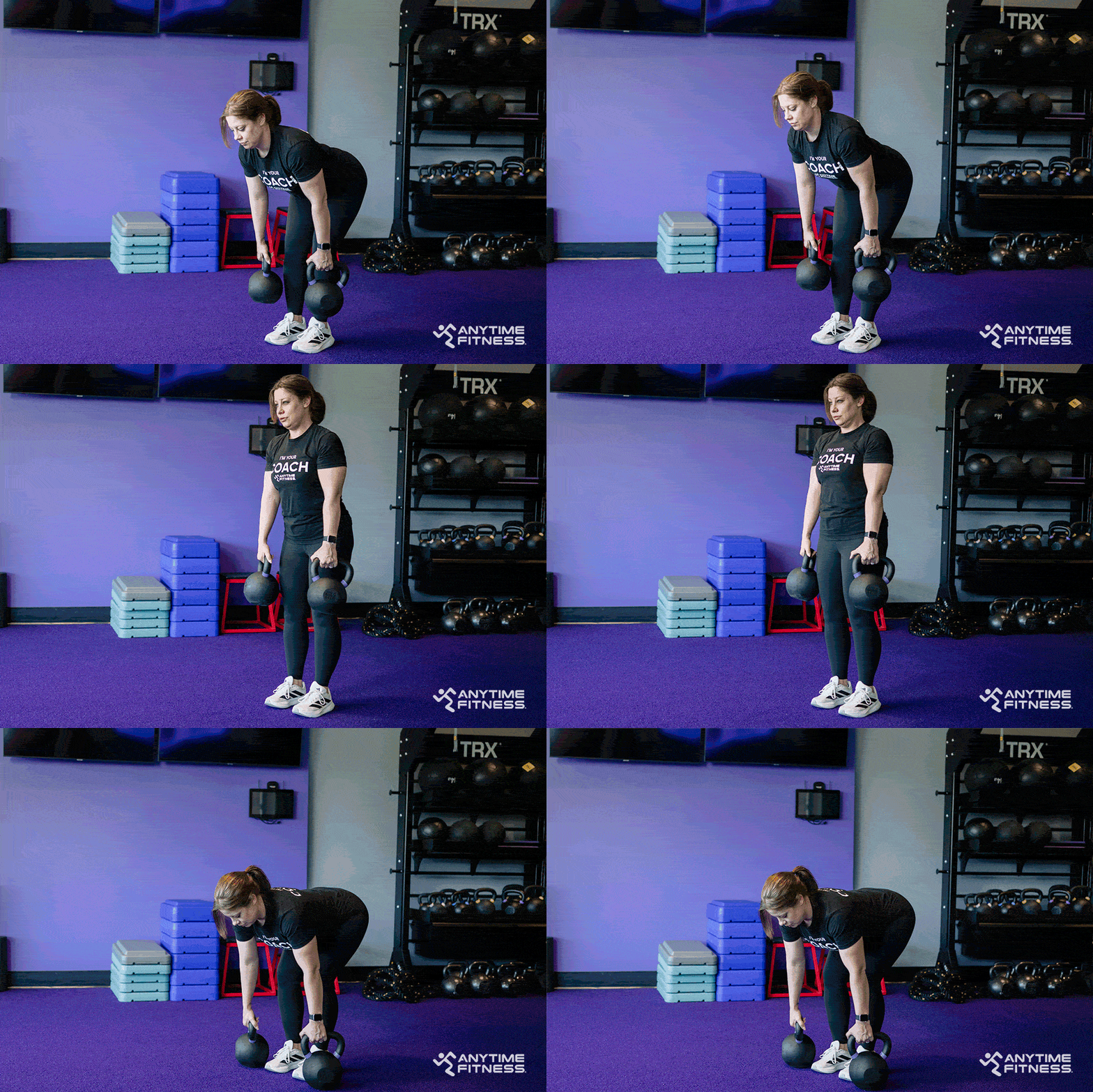
Deadlifts work your hamstrings, glutes, lower and upper back, and core, making them another powerhouse movement. Ensure you maintain proper form, as deadlifts can put a strain on your back if not performed correctly. A Coach or personal trainer is a great retarget to help with technique.
For more lower body exercise variation, try lunges and the leg press.
Upper-body push exercises
Bench press
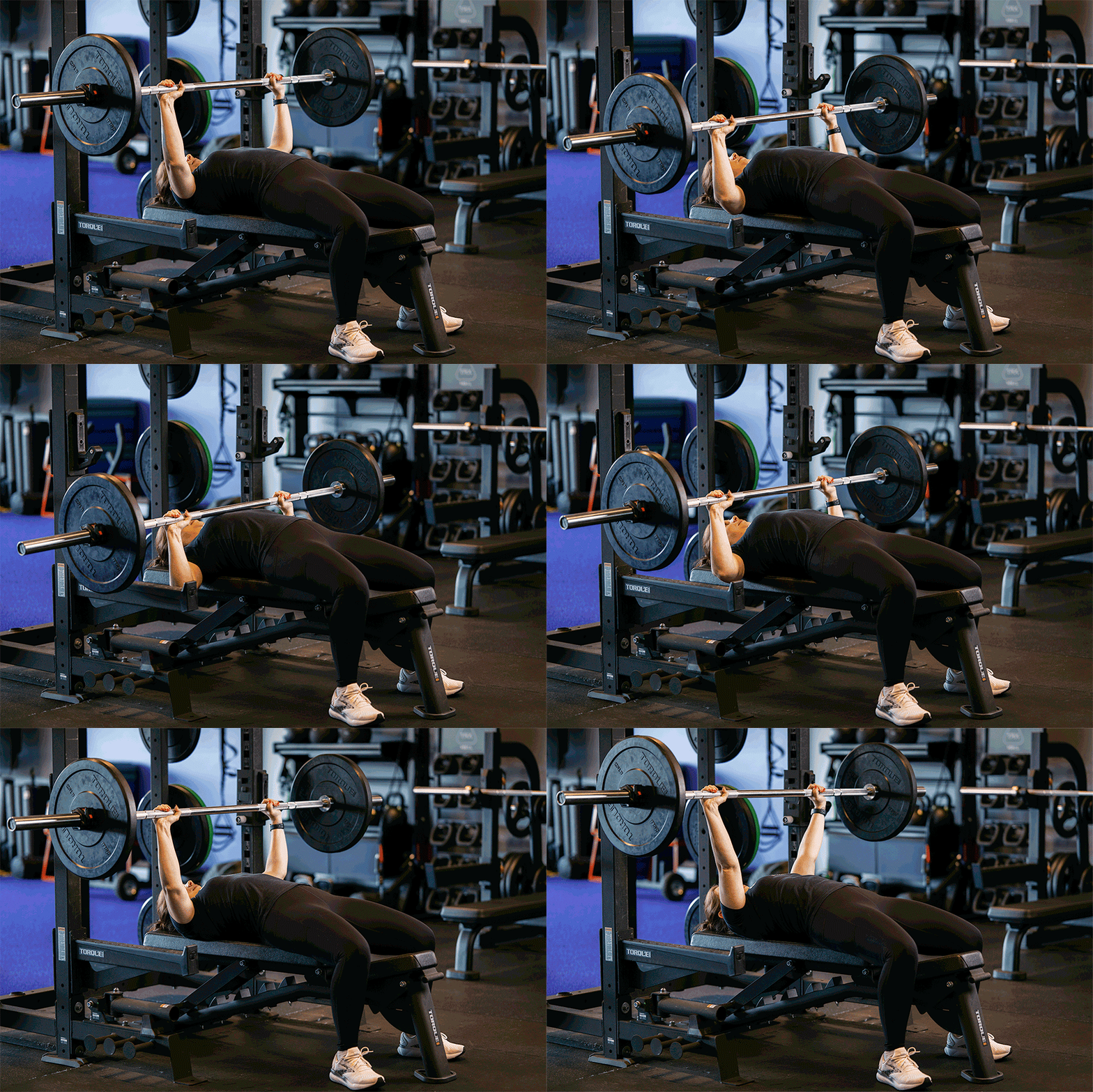
The bench press targets your upper-body muscles, including your chest, shoulders, and triceps. It’s a cornerstone for upper body strength and muscle mass.
Overhead press

The overhead press, also known as the standing press, targets the shoulders and triceps, offering a compound lifting solution for upper-body strength and stability.
For another upper-body push variation, try the incline press.
Upper-body pull exercises
Pull-ups and chin-ups

These are incredible for grip strength, work your upper back muscles, shoulders, and biceps, and provide a benchmark for true upper-body strength.
Add rows and face pulls to your upper-body pull exercise rotation for extra variety.
2. Workout routine structure: Reps, sets, and rest
How you structure your sets, reps, and rest can impact the results of your strength routine. Think of it as more than exercises — it’s really a system that provides defined progression, built-in accountability, and a gameplan for your week. As you build the structure that works for you, remember that striking a balance is key.
Sets and repetitions
Reps (the number of times you perform an exercise) and sets (a group of reps) are where the details of your workout routine start to take shape.
For general strength training, aim for three to five sets of each exercise. Reps will depend on your goal and the weight you’re using. For strength, aim for lower reps (six to eight) with heavier weights, encouraging maximal force exertion.
Higher reps and lower weight are more suited for toning and endurance while lower reps and higher weight are better to increase strength. Always ensure that you’re lifting a weight heavy enough that the last rep of each set is challenging, but still allows for proper form.
Rest periods
Allow rest between strength-training sets. For some heavier lifts, two to three minutes might be necessary to fully recover and perform the next set optimally.
Shorter rest periods (around 60–90 seconds) can promote muscular endurance and hypertrophy (when muscle fibers grow in size).
Hypertrophy happens when you create:
- Mechanical tension by lifting challenging loads
- Metabolic stress through time under tension and volume
- Muscle damage that is controlled and recoverable
However, the strength focus necessitates slightly longer rests (two to three minutes) to allow for adequate recovery between heavy sets.
Related: Creatine Before or After a Workout? Timing & Tips for Workout Recovery
[boxout]
Tools and equipment to support your workout
- Resistance bands: These are helpful for added volume (and practically weightless to carry to the gym).
- Machines: These are safer for pushing close to failure.
- Tempo training: This approach increases time under tension.
- Bodyweight (progressions): Bodyweight exercises are underrated for hypertrophy — no equipment required.
- Sled work/carries: These exercises promote functional hypertrophy.
Related: Gym Equipment 101: How to Use Leg Press, Curl, & Lift Machines
[/boxout]
3. Week-long workout plan: Schedule and frequency for muscle gain
How often you decide to work out each week will vary based on your goals, but a standard blueprint for strength-training workout routines typically includes targeting different muscle groups each day. (You can use our guide below to get a feel for this, ensuring you have rest or active recovery days in between to give your muscles time to recover and grow.)
Related: Your Step-by-Step Beginner Workout Routine for Moving Daily
Monday: Back & biceps
- Pull-ups or lat pulldown — Four sets of six to 10 reps
- Barbell row — Four sets of six to eight reps
- Seated cable row — Three sets of eight to 10 reps
- Face Pulls — Three sets of 12-15 reps
- Bicep Curls — Three sets of 10-12 reps
Wednesday: Chest, shoulders & triceps
- Bench press — Four sets of six to eight reps
- Incline DB press — Three sets of eight to 10 reps
- Overhead press — Three sets of six to eight reps
- Lateral raises — Three sets of 12-15 reps
- Triceps pushdowns — Three sets of 10-12 reps
Friday: Legs
- Back squat — Four sets of five to eight reps
- Leg press — Three sets of eight to 10 reps
- Walking lunges — Three sets of 10 reps per leg
- Leg extensions — Three sets of 12-15 reps
- Deadlift — Four sets of four to six reps
- Romanian deadlift — Three sets of eight to 10 reps
- Hamstring curl — Three sets of 10-12 reps
- Glute bridge — Three sets of eight to 12 reps
- Calf raises — Three sets of 12-15 reps
Depending on your workout type and schedule, you may start to feel stronger as early as weeks one to three. With consistency, you’ll likely begin to notice visible changes during weeks four through eight. Between weeks eight to twelve and beyond, muscle growth will become more apparent. Muscle growth takes time, so be patient with yourself as you build strength you can sustain.
Related: The Best Workout Split for Muscle Gain
4. Rest and recovery days
To gain muscle, rest days are just as important as the rest of your strength-training routine. It’s during the recovery phase that your muscles repair and grow. Not to mention, overtraining can lead to injury and hinder the great progress you’re making.
Rest days
When you build a workout plan, consider having one full rest day a week, and listen to your body for signs of fatigue or overtraining. This is where you don’t do any low- or high-impact activity.
Active recovery days
You can also incorporate active recovery workouts when you build a workout plan, which use low-intensity exercises to help your body release tension and decrease muscle soreness.
Related: 7 Yoga Poses for Stretching After a Workout
Personal Coaching: The secret to making a workout plan that actually works
Ok, so now you have the pieces to consider when making a workout plan. But here’s the catch: Even the most detailed guide can’t replace the expertise and guidance of a personal Coach.
Investing in a trainer can save you time (and possible detours down less effective paths along your fitness journey, especially if you’re a beginner). They can help create or refine workout routines designed to build muscle, suggest adjustments, and provide support and expertise every step of the way.
Personal Coaches offer so many benefits, including:
- Effective workouts personalized to your specific goals
- Accountability and motivation on days when you need a little boost
- Long-term knowledge that you can use for years to come
- Lesser risk of injury
Related: Fitness Coach vs. Personal Trainer: Which Is Right for You?
Your roadmap to strength and longevity
Knowing how to create a muscle-building workout plan is as much an art as it is a science. The most effective workout plan is the one that takes into account your individual goals, body composition, and lifestyle. It should evolve as you do, continually challenging you and promoting steady progress.
Remember, while guides like this provide structure, there’s no one-size-fits-all approach. If you’re in doubt, seek the advice of a qualified personal trainer for next-level support.
Put it into practice: 5 strength-training workout routines to try
- Ultimate Flex: Pull Day Workout Routine for Max Muscle Gains
- 5 Push Day Workout Exercises for Stronger Arms and Chest
- 15-Minute Beginner Bicep Workout to Tone and Strengthen
- The Full-Body Conditioning Workout Everyone Should Try
- E.M.O.M. Strength Builder Routine
Boost your power, muscle mass, and overall physical longevity with one-on-one guidance from a Coach. Schedule a FREE fitness consultation to get started.


.jpeg)