


Skipping cardio workouts because you’re concerned they’ll hinder muscle growth? So last season! It’s a common misconception that cardio interferes with muscle gain — but cardio machines, like the exercise bike, can be a valuable asset to your strength routine and overall health.
Exercise bike workouts can support muscle growth and recovery when programmed effectively. If you’re looking for more ways to diversify your routine and optimize gym equipment, overlooking the exercise bike could mean you’re missing out on some serious progress. Let’s talk about how bike workouts that can elevate your fitness routine. We’ll cover:
- How bike workouts build strength, endurance, muscle, and more
- How to incorporate bike workouts into your routine
- How to build muscle on a bike
- Ideal bike workouts and schedules for fat loss and muscle gain
Benefits of adding bike workouts to your routine
While biking sessions can be intense and raise your heart rate (HR) levels similar to running, their benefits extend beyond cardio. The exercise bike is one of the most efficient for building endurance, supporting recovery, and enhancing lower body strength. With consistent use, you can build a schedule that includes productive recovery days and see steady fitness growth.
1. Biking is a low-impact, high-output cardio exercise.
Unlike other cardio formats like running and plyometrics where there is impact (pounding) on your knees, hips, and back, biking is joint-friendly. Cycling workouts support your weight, keeping impact low while maintaining high intensity.
This means you can:
- Push and increase intensity multiple times per week
- Include cardio without compromising leg day recovery
- Stay consistent during high-volume strength phases
2. Biking offers versatile intensity control.
Stationary bike workouts are great for precision programming. The bike allows you to manipulate resistance, cadence (RPM), and duration. Rather than 30 minutes of pedaling at the same pace, you can tailor cycling workouts to target specific fitness goals.
3. Biking helps build muscular endurance.
Cycling targets your quads, hamstrings, and glutes. With low-impact movement and no additional weights, cycling builds endurance without straining muscle. Rather than competing with strength and muscle gains, cycling complements them.
Frequently engaging in bike workouts can help you:
- Improve local muscular endurance
- Support work capacity for lifts (squats, lunges, deadlifts)
- Avoid excessive soreness
4. Biking is an efficient cardio workout.
If you’re short on time, a 25-minute exercise bike workout can burn calories and improve stamina while strengthening your lower body muscles. Not many machines can offer the same level of intensity and efficiency.
Time-efficient cycling workouts can help you achieve high-impact results by:
- Alternating sprints and recovery
- Riding at high resistance intervals
- Keeping recovery periods brief and active (you don’t have to come to a full stop)
Bike workouts maximize your time at the gym without the need to commit to another hour-long session for an intense workout.
5. The bike is a versatile warm-up or finisher tool.
The bike can seamlessly fit into any part of your training schedule. It’s one of the rare pieces of equipment that can target several areas in just one program. Here’s how it can be used:
- Warm-up: Biking can gradually elevate the heart rate to prepare your body for lifting.
- Finisher: Biking can be done in short, intense intervals to empty the tank and maximize calorie burn.
- Active recovery: Incorporate exercise bike workouts with low-intensity rides between heavy lifting days to promote active recovery.
6. High-intensity exercise bike workouts offer stability control.
If you’ve ever sprinted on a treadmill, you know the injury risks that come with doing intense cardio while fatigued. Tripping, falling, or taking a rest day to recover can throw off your whole schedule (and let’s be honest — hurt your ego). With cycling fatigue, you simply slow down when you gas out.
This makes the bike an effective tool for:
- Training close to failure
- Pushing cardiovascular limits safely
- Independent workouts (no spotter required)
[boxout]
How stationary bike workouts build muscle
Stationary bike workouts strengthen your lower body through consistent engagement with your quads, glutes, and hamstrings. High-resistance cycling forces your muscles to push against the resistance, resulting in muscular growth. This means you’ll approach bike sessions like strength work rather than a cardio workout only. Instead of building stamina and endurance, aim for high-intensity and high-resistance routines that support muscle gain by:
- Increasing your resistance and riding at a lower cadence (50-70 RPM)
- Working close to fatigue
- Sustaining time under tension (keeping muscles actively moving)
[/boxout]
Cycling terms to know: Resistance, cadence, and duration
If you’ve ever tried an exercise bike workout plan, you’ve probably come across terms like resistance, cadence, and duration. These variables define your sessions, shape how you cycle, and impact your progress. Understanding what they mean and how they are applied to the exercise bike is critical to making your workout plan work for you — and improving your results. Here’s a rundown.
Resistance
Resistance is about how hard you pedal; the greater the resistance, the harder you have to pedal. Set the resistance too light and you could be missing out on muscle-building and calorie-burning benefits. Increasing resistance leads to higher intensity, metabolic effort, and strength gains.
Cadence
Cadence is how fast you’re pedaling. It is measured through revolutions per minute (RPM) – how many times you complete a full spin. Cadence can also represent your resistance and intensity. Note: A lower cadence (fewer spins) doesn’t always indicate higher resistance. While a resistance can slow you down, advanced or intensive cycling can achieve a high cadence even with increased resistance.
Example:
- High cadence: 80-100 RPM
- Low cadence: 60-70 RPM
Duration
Duration is how long you spend pedaling. For short but intense workouts like high-intensity interval training (HIIT) on an exercise bike, , you may only need about 25 minutes of pedaling. Endurance-based workouts may last anywhere from 45 minutes to an hour or more.
25-minute exercise bike workout plan for fat loss
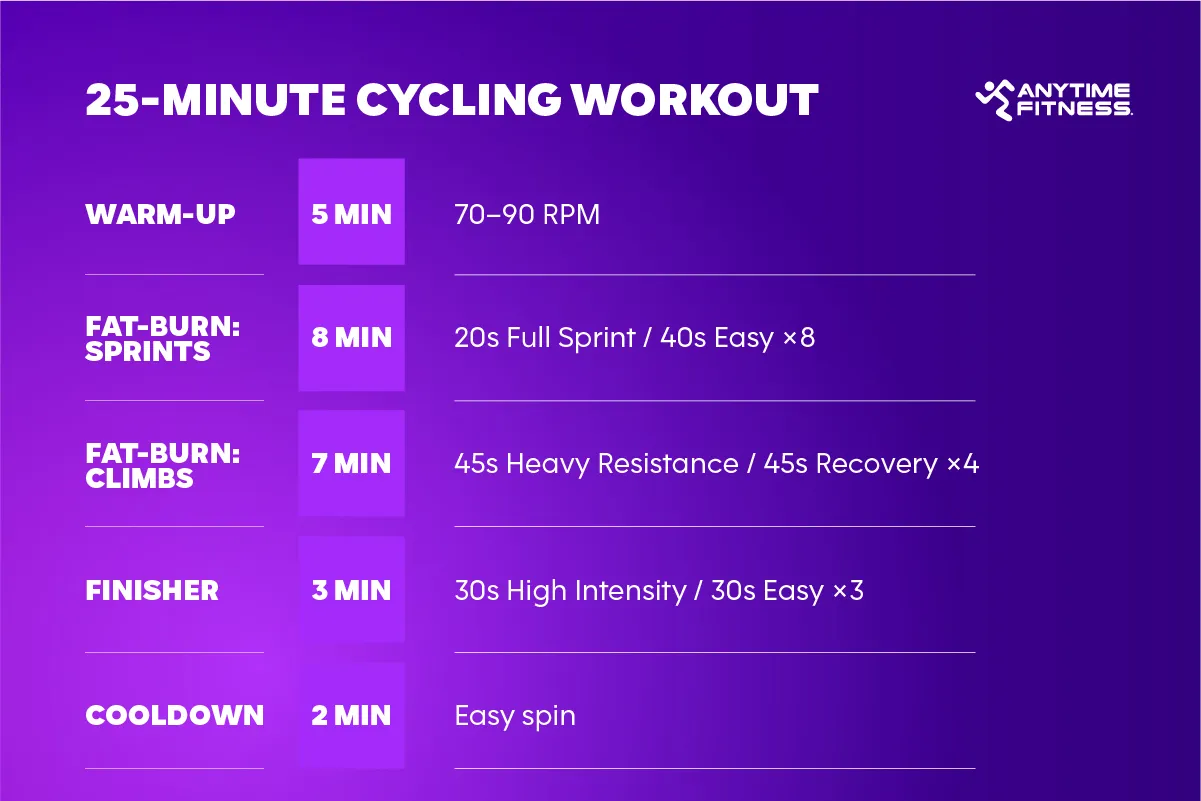
This session focuses on burning fat by maximizing calorie burn, maintaining muscle mass, and improving cardio conditioning. For this workout, an upright bike will be the most ideal, as it offers precise resistance and intensity control.
The workout begins with a five-minute warm-up before 15 minutes of high-intensity cycling with low-intensity intervals between. The workout wraps up with a two-minute cooldown. Here’s how it works:
1. Warm-up (5 minutes)
- Start with an easy pace and gradually increase resistance.
- Cadence: 70–90 RPM
- Effort: 4–5/10
Goal: Raise heart rate, prepare legs without fatigue.
2. Fat-burning intervals (15 minutes total)
Block A: Power sprints (8 minutes)
- Start a full-speed sprint for 20 seconds (higher resistance, fast cadence).
- Transition to a 40-seconds easy spin.
Repeat these intervals eight times.
Focus: Push for maximum effort on sprints — this drives the biggest calorie burn.
Block B: Climbing endurance (7 minutes)
- Pedal for a slow and controlled 45-seconds heavy resistance climb (50–70 RPM).
- Then start a 45-seconds moderate pace recovery.
Repeat these intervals four times.
Focus: Legs should feel loaded. This session helps you build muscular endurance while burning fat.
3. Finisher (3 minutes)
- Start with a high-intensity 30-second cycle.
- End with an easy 30 seconds.
Repeat these intervals three times.
4. Cooldown (2 minutes)
- Start a very light spin.
- Take deep breaths to bring your heart rate down.
30-minute exercise bike workout plan for muscle gain
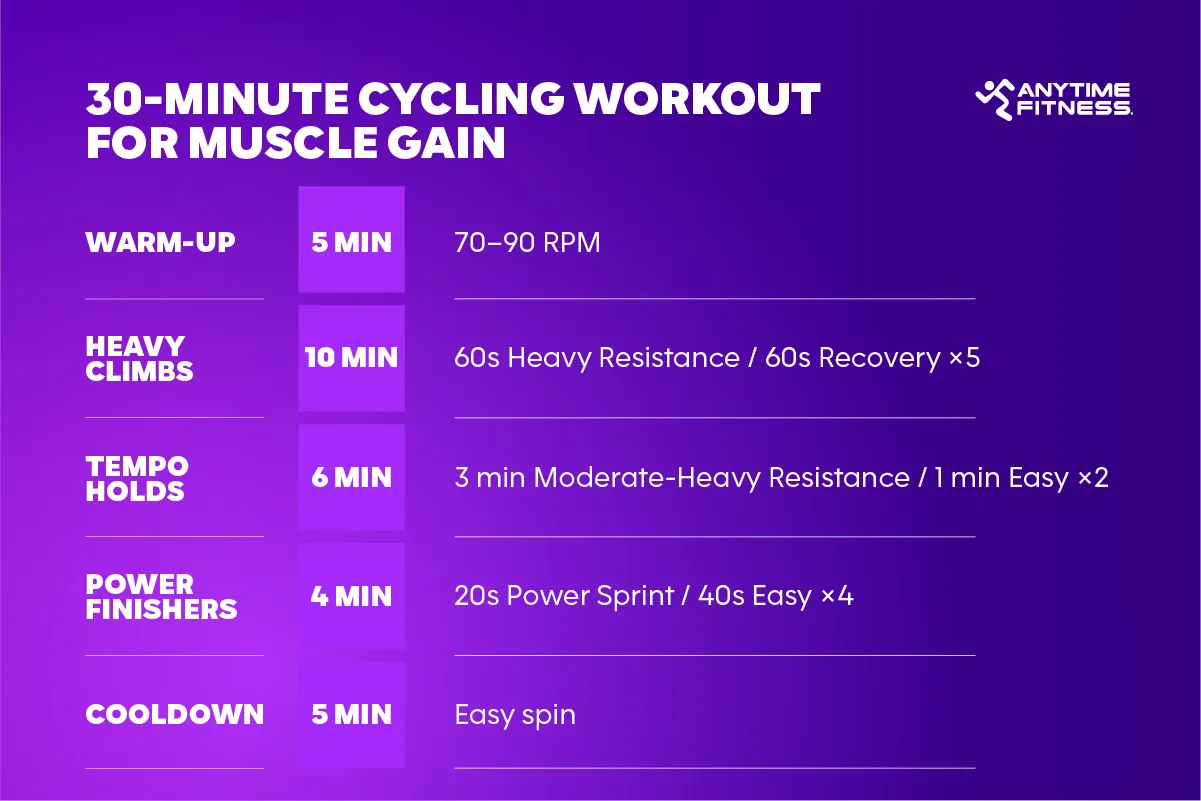
This 30-minute bike workout (ideally done on a spin bike) focuses on building lower-body muscular endurance, strength, and definition.
The workout starts with a five-minute warm-up to raise your HR, then challenges you to 20 minutes of high-intensity interval training. Within each interval, you can expect a few seconds of slow and low-intensity cycling for recovery. Then, you’ll finish with a five-minute cooldown.
1. Warm-up (5 minutes)
- Start with a light pace and gradually increase resistance.
- Cadence: 70–90 RPM
- Effort: 4–5/10
Goal: Prep joints and activate quads, hamstrings, and glutes.
2. Strength intervals (20 minutes)
Block A: Heavy seated climbs (10 minutes)
60 seconds of heavy resistance (slow grind)
- Cadence: 50–60 RPM
- Effort: 8–9/10
60 seconds of moderate recovery
- Cadence: 70–80 RPM
- Effort: 5–6/10
Repeat these intervals five times.
Focus: Stay seated and push and pull through the full pedal stroke. This targets your glutes and quads.
Block B: Tempo strength holds (6 minutes)
Ride for three minutes of continuous moderate-heavy resistance.
- Cadence: 60–70 RPM
- Effort: 7–8/10
Transition to a one-minute easy spin.
Repeat this two times.
Focus: Feel constant tension. Avoid bouncing in your seat or coasting.
Block C: Power interval finishers (4 minutes)
Start a 20-second high resistance sprint (power-focused, not just speed).
- Cadence: 70–80 RPM
- Effort: 9/10
Transition to a 40-second easy spin.
Repeat these intervals four times.
Focus: Drive hard through the pedals. Try to think: “Explode, not spin.”
3. Cooldown (5 minutes)
Gradually reduce resistance.
- Cadence: 70–90 RPM and transition down to a easy spin
- Effort: 3–4/10
Goal: Flush the legs and kickstart recovery.
How to build an effective cardio routine with an exercise bike
Planning a cycling workout is one thing, but seamlessly programming them into your existing workout split is another. Building a structured schedule will help you balance intense biking days with leg days or heavy lifting sessions to help you train more consistently.
Tips to build an ideal schedule that balances training volume throughout the week to avoid overtraining:
- Separate intense bike work from heavy leg days. Aim for 24–48 hours of separation when possible to allow muscle recovery.
- Use the fat-burning workout on upper-body or non-lifting days. Fat-burning rides require a higher cadence to get your heart rate up and burn fat. (It’s easier to do this on “fresh” legs!)
- Use the muscle-building ride as a lower-body accessory or replacement day. This workout trains large and small muscle fibers to fail between lifting and riding for maximum muscle build post-workout.
- Keep total weekly stress in check (two to four bike sessions max for most).
Sample 1-week training schedule: 4 lifts + 2 bike sessions
Day 1: Lower body strength (heavy)
- Sample exercises: Squats, RDLs, lunges
- No bike (or optional five- to 10-minute easy warm-up)
Try this: 15-Minute Ultimate Leg Blaster Workout
Day 2: Upper body strength
- Sample exercises: Bench, rows, shoulders
- 10- to 15-minute easy spin (recovery)
Try this: 5 Push Day Workout Exercises for Stronger Arms and Chest
Day 3: Fat-burning bike workout (25-minute HIIT)
- Standalone bike session
- Focus: Conditioning and calorie burn
Try this: 25-minute exercise bike workout for fat loss (see above!)
Day 4: Lower body strength (moderate volume)
- Higher reps, accessory work
- Sample exercises: Leg extensions, stability ball hamstring curls, hip thrusts
- No cycling
Try this: 8 TRX Leg Exercises to Tone Your Lower Body
Day 5: Upper body and short finisher
- Sample upper-body lift exercises: Bicep curls, tricep extensions, pec flys, rear delt flys
- Five- to 10-minute light/moderate bike finisher
Try this: Fast Track to Strong Arms: Beginner-Friendly Arm Workout
Day 6: Muscle-building bike workout (30 minutes)
- Acts like a leg accessory day, increasing training volume, improving conditioning, and building endurance
- Focus: Tension, climbs, and endurance
Try this: 30-minute exercise bike workout for muscle gain (see above!)
Day 7: Rest or active recovery
- Walk, mobility, or very light cycling
Try this: Active Recovery Workout for Muscle Repair and Growth
Exercise bike workouts: High-intensity cardio that doesn’t hurt your gains
It’s time to stop sleeping on the exercise bike! Whether you are aiming to build muscle or in recovery, cycling can become an integral part of your routine with the right techniques and approach. Exercise bikes provide a workout that’s easily customizable to your goals and schedule — with every ride, you’ll feel stronger, build cardio endurance, and get one step closer to your fitness goals.
More strength training and cardio tips for you
- Progressive Overload: The Strength Principle You Need to Know
- Elliptical or Treadmill: Which Cardio Machine is Best?
- Maintain Strength: Take Rest Days for Muscle Growth
Ready to add the exercise bike to your strength and cardio routine? Connect with a Coach today to get a personalized training, nutrition, and recovery plan based on your goals.