


If you’re experiencing fatigue, burnout, or a plateau in your results, incorporating a deload week (aka periodically dialing back your workout intensity) could be the solution that amps up your results. Is a deload week right for your training schedule? We’ll help you decide whether to deload (and how often), and cover:
- The benefits of taking a recovery week
- What a successful deload looks like (with sample deload workout schedules)
- Signs your body needs time to recover
The benefits of adding a deload week to your strength routine
While recovery should always be part of your training routine, deloading has its perks. A 2024 study showed that those who had a one-week deload period in the middle of a nine-week training block had no less muscle size, endurance, or power compared to those who trained continuously for nine weeks. In fact, scaling back during certain phases of your training routine can actually help you get better results in the long term. How? Consider these commonly cited benefits of deload weeks:
- Reduced fatigue and risk of overtraining
- Preparedness for the next training phase
- Enhanced overall performance
- Improved physical and mental recovery
In a recent survey, fitness trainers also agreed that “the purpose of deloading is not to enhance performance per se, but to mitigate physiological and psychological fatigue, promote recovery, and facilitate physiological adaptation.” The trainers also shared that clients who integrate periodic deload weeks are more likely to adhere to their programs. In other words, scaling back strategically can help you stick to your routine long-term.
Note: While deloading has clear benefits for some, incorporating a deload week isn’t required if you’re consistently making progress while feeling healthy and energized.
How to do a successful deload
A deload week is different from taking a week off from working out — that’s a rest week. During a deload week, you intentionally lower the intensity of exercise to allow your body to recharge and recover while staying active. A successful deload week will leave you feeling refreshed, energized, and ready to take on your next training phase.
Here are some strategies to bring down the intensity and change up your routine during a deload week:
- Reduce volume by performing fewer sets and reps.
- Lift lighter weights (by up to 50%).
- Increase rest time between sets or use less intense modifications during your workouts.
- Do other activities or sports like pickleball, rowing, or bodyweight circuits.
The phases of periodization training: What to know before you deload
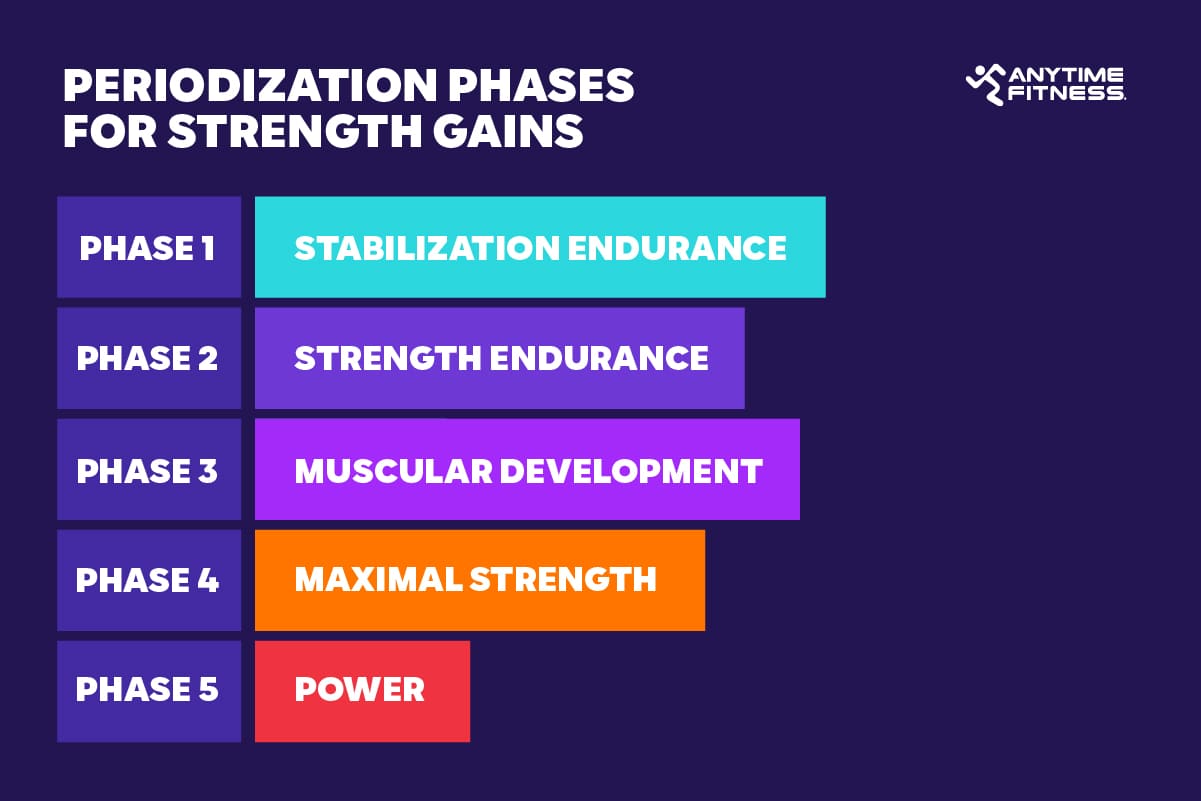
The sample deload workouts and schedules listed below follow the principles of periodization, which divides your training cycle into strategic phases. Each consecutive phase builds on the last to encourage continuous adaptation and growth. Here’s an overview of each phase:
- Phase 1: Stabilization endurance
- Phase 2: Strength endurance
- Phase 3: Muscular development
- Phase 4: Maximal strength
- Phase 5: Power
Depending on each athlete’s unique goals, their training plan may cycle through all five phases, or just a few. Deload weeks can land between two phases or at the end of a training cycle — it takes time to find what fits your schedule and goals best!
How often should you deload?
If you’re newer to regular exercise, consider deloading every eight to 12 weeks. Forming a consistent routine is essential to success during your initial training phases. (See sample schedule 1 below!)
While you're (hopefully!) focusing on the fundamentals like stability, form, and control, regular recovery methods like stretching, foam rolling, and active recovery workouts (in addition to getting enough sleep) are typically sufficient for muscle recovery in the early phases of training, like stabilization endurance and strength endurance.
If you’re further along in your training cycle (i.e., you’re focused on hypertrophy or maximal strength), you may deload as often as every four weeks.
How to know when it’s time for a recovery week
Aside from the calendar, another way to know when it’s time for a deload week is to listen to your body’s signals. Overtraining is possible if you’re exerting at a high level and not recovering enough in between workouts. So, how do you know if you’re overdoing it? Here are common signs of training stress:
- Chronic fatigue
- More frequent illness or injury
- Changes in digestion
- Poor sleep
- Mood changes and irritability
Note: Always see a doctor if you’re experiencing any of these symptoms, as they could be a sign of underlying conditions.
Deload workouts: Sample schedules by goal and experience
Ready to try a deload week? To help you get started, we’ve created three sample deload schedules based on specific goals and experience levels. While the best workout split is the one that works for your schedule and goals, the first sample routine is useful if you’re a beginner laying the foundations for your strength routine. The second and third sample routines follow linear periodization and undulating periodization, respectively, and are helpful if you’ve already established a consistent training split.
Sample 1: Stabilization and strength endurance for beginners
This sample training plan is perfect if you’re a beginner strength trainer working to establish a routine before deloading.
Weeks 1-4: Phase 1 (stabilization endurance)
Stabilization endurance priorities:
- Focus on movements for muscular endurance (light weight, high reps).
- Prioritize joint range of motion plus joint and core stability.
- Practice balance and exercises for mind-muscle connection.
Weeks 5-8: Phase 2 (strength endurance)
Strength endurance priorities:
- Improve strength and muscular endurance through supersets.
- Repeat each superset two to four times, performing eight to 12 reps per exercise.
- Perform one to two supersets per muscle group.
Week 9: Deload Week
During your deload week, try doing fewer sets and reps of each exercise or opt for a different workout like swimming or rowing.
Repeat the cycle after week nine.
Sample 2: Linear periodization
Here is an example training routine that follows the NASM OPT Model. This routine integrates a deload week and cycles through hypertrophy training (for mass) and maximal strength training (for strength gains) using linear periodization. This strategy is helpful if you want small, predictable increases in intensity over time and consistent intensity throughout the week — perfect if you’re focused on building a strong foundation or rehabbing an injury.
Weeks 1-4: Phase 3 (hypertrophy training)
Hypertrophy training priorities:
- Increase the volume (weights and reps) of your workouts.
- Use moderate to heavy weights.
- Perform six to 12 reps per set.
Week 5: Deload week
During your deload, focus on the same exercises as weeks one through four at a lower intensity or volume.
Weeks 6-10: Phase 4 (maximal strength training)
Maximal strength training priorities:
- Perform four to six sets of one to five reps.
- Use an explosive rep tempo.
- Do two to four exercises per muscle group.
Week 11: Deload week
Repeat the cycle after week 11.
Sample 3: Undulating periodization
This sample training plan shows how to integrate deload weeks with undulating periodization (alternating between strength training and hypertrophy training within the same weekly training split). Undulating periodization is useful if you crave variety in your routine, as workout styles and intensity change throughout the week to address multiple strength goals at the same time.
Weeks 1-4
- Monday: Hypertrophy
- Wednesday: Hypertrophy
- Friday: Maximal strength training
Week 5: Deload week
During your deload sessions, focus on the same exercises as weeks one through four at a lower intensity or volume.
Weeks 6-10
- Monday: Hypertrophy
- Wednesday: Maximal strength training
- Friday: Maximal strength training
Week 11: Deload week
Repeat the cycle after week 11.
Add a deload week to pump up progress
While it may feel counterintuitive, taking a step back from your training could be an effective way to enhance your performance and results in the gym. Think: better recovery, increased strength, and more muscle mass over time. While recovery is always essential no matter which training phase you’re in, taking a deload week turns down the intensity of your workouts but keeps your muscles moving to leave you feeling refreshed, recharged, and ready to show yourself just how much you’re capable of.
More health and fitness tips for you
- Exercise to Increase Longevity: How to Improve Grip Strength
- Pro Tips for Scheduling Exercise and Getting Back to a Regular Strength Routine
- More Muscle, Less Fat: A Body Recomposition Guide
Want one-on-one Coaching support, personalized macro breakdowns, and custom workout plans to take your training to the next level? You’re in the right place — find an AF Coach to get started.