

If you're using a GLP-1 medication, you've likely seen the number on the scale drop. (Or, if you’re considering starting one, this may be your goal.) And while that’s important (and exciting!), it’s one piece of data that makes up a broader picture of progress. Successful, sustainable results can be built — and maintained — with a thorough understanding of one key concept: fat loss vs. weight loss.
Losing fat while keeping essential, metabolism-driving muscle is often the crucial balance that can transform your body for good. This guide will help you understand the difference between the two, debunk common myths, and provide a clear roadmap for fitness and nutrition best practices while on a GLP-1.
In this blog, we’ll cover:
- Fat loss vs. weight loss: What’s the difference?
- Common misconceptions about weight loss and body composition
- Seven-day workout plan to lose weight and preserve muscle mass
- How to track fat loss with the Evolt 360 body composition scanner
Fat loss vs. weight loss: What’s the difference while on a GLP-1?
If weight loss is your goal, seeing that happen over time can be a satisfying step forward. During this time, one thing that can be helpful to understand is that weight loss doesn’t always equal fat loss. Weight loss simply means the number on the scale is going down. This can come from fat loss in some cases, or it can come from muscle tissue and water.
Fat loss, on the other hand, means you’re specifically reducing body fat while preserving lean muscle. This transformation process improves metabolism, strength, appearance, and long-term health.
Taking GLP-1 medications can be a very effective way to reduce appetite and total calorie intake, which can lead to weight loss (seen on the scale). However, without strength training and prioritizing protein, a significant portion of weight lost can come from muscle, not just fat.
Because muscle is metabolically active tissue, it’s important to maintain this throughout the weight loss process. Muscle helps regulate blood sugar, supports joint health, drives metabolism, and keeps people strong, capable, and independent into their later years — just to name a few of its many benefits.
3 common misconceptions about weight loss & body composition
As mentioned, GLP-1s can help reduce appetite, but they don’t protect your muscle or optimize your metabolism. So, when taking a GLP-1, the real goal isn’t just weight loss. It’s fat loss with muscle preservation.
Pairing GLP-1 use with strength training, adequate protein, and body composition tracking is what turns short-term weight loss into long-term success. Read on for three common misconceptions — and the facts that can help you gain a better understanding of this process.
Myth 1: “If the scale is going down, I’m losing fat.”
This can be true in some cases, but it’s not necessarily always correct. The scale reflects everything: fat, muscle, and water. With reduced appetite and rapid calorie deficits on GLP-1s, a significant portion of weight loss can come from muscle. This can cause problems related to metabolism, strength, and maintaining long-term results.
Myth 2: “I don’t need to strength train if I’m losing weight.”
This is one of the most important myths to debunk. Without resistance training, your body has no reason to hold onto muscle, meaning it can start to disappear over time. Strength training tells your body: keep the muscle, burn the fat.
Myth 3: “Once I hit my weight loss goal, I’m done.”
Reaching a weight loss goal is certainly something to be proud of, but rather than stopping the work you’ve put in, it marks a shift toward maintenance to preserve your body composition. Building muscle, healthy habits, and metabolic capacity as you lose weight on a GLP-1 will help prevent regaining weight once you’ve reached your goal.
Workout to lose fat & preserve muscle mass
As we’ve covered, exercise and GLP-1s go hand in hand. Ready to put it into action? Use this seven-day workout routine designed to help you lose fat on a GLP-1 while also preserving muscle mass.
Monday: Full-body strength & core
- Goal: Build total-body strength and stimulate muscle maintenance.
- Focus on large, compound movements (e.g., squats, rows, presses) to recruit major muscle groups.
- Include targeted core work to support stability and posture.
Tuesday: Low-intensity steady state (LISS) cardio (30 min)
- Goal: Boost circulation, burn fat, and aid recovery without draining energy.
- Choose a light, steady-state activity like brisk walking or cycling.
- Stick with a pace that allows you to still hold a conversation.
Wednesday: Upper-body strength
- Goal: Stimulate hypertrophy and strength in the upper body while managing volume.
- Focus on upper-body compound exercises (e.g., push/pull movements).
- Include accessory work for joint health (e.g., rotator cuff, posture muscles).
Thursday: Rest or light cardio
- Goal: Allow your body to rest and recover.
- You can use this as your “off day” if you feel your body needs a break. If you’re craving movement, consider a walk or another activity with less intensity than a typical workout.
Friday: Lower-body strength & mobility
- Goal: Preserve strength and support joint health.
- Focus on compound lower-body lifts (e.g., deadlifts, lunges) to maintain muscle mass.
- Add mobility work to reduce stiffness and improve movement quality.
Saturday: Optional HIIT or LISS
- Goal: Tune into what your body needs.
- If you’re feeling up for another workout, use this day for a HIIT workout (high intensity interval training) or the LISS (low-intensity steady state) cardio exercise options covered above.
Sunday: Rest or recovery walk
- Goal: Allow yourself to take a break (so you can keep the momentum going!).
- This is a day to focus on rest and recovery, which could mean taking the day off or going for a walk in your neighborhood or on the treadmill.
Related: How to Prevent GLP-1 Muscle Loss Through Exercise
How to upgrade an existing workout routine for fat loss
If you’re taking a GLP-1 (or preparing to take one) and already have a workout routine, you can make several simple additions to focus on preserving muscle and losing fat. One of these essentials? You guessed it: strength training.
Make sure your workout routine includes strength training three to four times per week, and prioritize compound lifts for efficiency and effectiveness. We recommend adding in these specific exercises as well:
- Squats
- Deadlifts
- Bench press
- Bent-over rows
- Pull-ups
- Lunges
- Overhead press
Track fat loss vs. muscle mass with the Evolt 360 body composition scanner
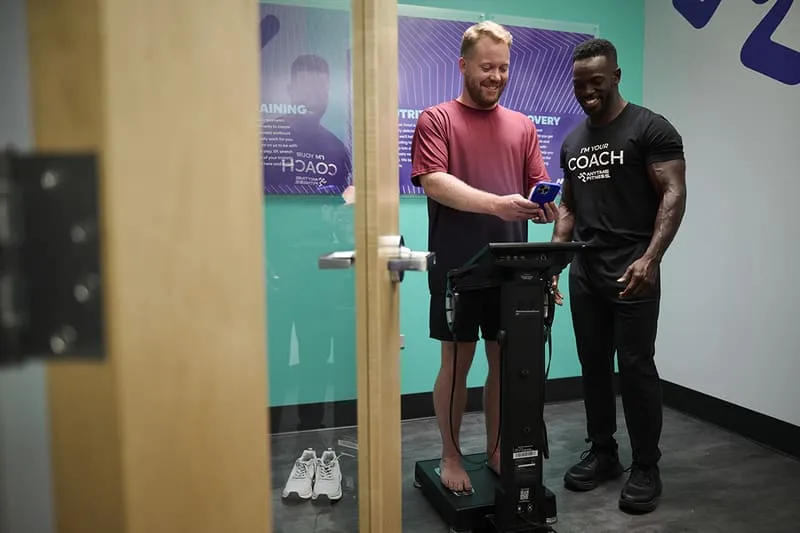
The best way to understand the difference between weight loss and fat loss for your own body is with data. The Evolt 360 body composition scanner measures fat mass, lean muscle mass, and hydration.
These all help to determine what makes up someone’s body mass (what the weight number from the scale consists of) and can inform which changes to make to workout plans as necessary. You can visit an Anytime Fitness location near you to get started with a fitness consultation.
Setting realistic, sustainable fat loss goals
Even on a GLP-1, you may notice stagnant weight on the scale. This can still happen when fat loss and body composition changes are taking place. To set realistic, sustainable fitness and nutrition goals that align with body composition and overall health objectives, keep in mind that a stalled scale doesn’t mean stalled progress.
If body fat is decreasing and strength or muscle is being maintained, you’re moving in the right direction, even if your body weight isn’t changing. The key is shifting your goal from a certain number on the scale to seeing progress with healthy body composition. Instead of only chasing a number, aim to:
- Decrease body fat percentage
- Maintain or build lean muscle
- Improve measurements, strength, and energy levels
Remember: Strength training should be non-negotiable, three to four times per week to protect muscle and metabolism. Nutrition goals should include prioritizing protein, fiber, and eating consistently, not just eating less. Because GLP-1s suppress appetite, under-eating protein is one of the fastest ways to lose muscle.
Instead of the scale, using progress markers like body fat percentage, measurements, workout performance, sleep, and energy will reflect your health and goals more holistically. To do this, set timelines that support sustainability (think: steady fat loss and strength gains) and habits you can keep long-term.
Related: What to Eat on a GLP-1 Diet, According to a Dietitian
Other signs of fat loss progress to watch for
The Evolt 360 body composition scanner is helpful for understanding key data and how it changes over time based on your progress. But what about other signs of fat loss (rather than muscle)? As you lose fat, you’ll likely begin to notice signs in subtle, everyday moments.
For example, you might notice clothes starting to fit more loosely, or that you have more energy than usual. Sleeping better and noticing an improved mood are also indicators that you’re losing fat and maintaining muscle. These can take time to show up, so if you’re not noticing changes just yet, don’t worry.
Not seeing progress? Try making these changes
In some cases, you may be losing weight but not fat while on a GLP-1. If the scale is going down but body fat isn’t, it usually means too much of the weight loss is coming from muscle, water, or glycogen — not fat. Here’s what to do:
- Make strength training non-negotiable using the workout above
- Prioritize protein (even when you’re not hungry)
- Avoid extreme calorie deficits
Another uncomplicated tool that can be used for general weight loss is the “30, 30, 30 rule”, which involves:
- Eating 30 grams of protein during breakfast to reduce cravings afterward
- Eat breakfast within 30 minutes of waking up for healthy weight maintenance
- Getting 30 minutes of exercise after breakfast to keep your exercise routine consistent
Gaining weight — and losing fat — due to strength training on a GLP-1
When you lift weights consistently, your body can build or preserve lean muscle mass. Muscle is denser than fat, so it takes up less space but weighs more. At the same time, GLP-1 medications make it easier to eat fewer calories and lose body fat. When those two things happen together, the scale can stay the same, or even go up slightly, while your body fat percentage drops and your measurements shrink.
This is not only common, it’s actually a positive outcome if you’re on a GLP-1 and doing consistent strength training. In other words: You can look leaner, feel stronger, and be healthier even if the scale doesn’t move the way you expect.
This is especially common in the first eight to 16 weeks of starting strength training seriously for the first time (or after returning from a long break). The body is recomposing, trading fat for muscle.
Key takeaways for fat loss vs. weight loss on a GLP-1
Successfully navigating your fitness journey while using GLP-1 medications is about more than just watching the scale go down — it's about ensuring you’re losing fat instead of valuable muscle (reflected in body composition scans).
To recap, here are the key takeaways for achieving meaningful results:
Fat loss vs. weight loss: Generally, fat loss is better than weight loss on a GLP-1. True progress comes from reducing body fat while preserving lean muscle, which is essential for a strong metabolism and long-term health.
Strength training is non-negotiable: Incorporating resistance training signals your body to keep muscle, even in a calorie deficit. Compound lifts like squats, deadlifts, and presses are your most effective tools.
Prioritize smart nutrition: GLP-1s can suppress appetite, making it crucial to prioritize protein to protect muscle mass. Care for your body and fuel your workouts with small, nutrient-dense snacks to maximize your efforts.
Track what matters: The number on the scale doesn't tell the whole story. Use tools like the Evolt 360 body composition scanner to measure fat loss, muscle mass, and other key metrics that reflect real progress. Clothes fitting better and increased energy are also powerful indicators of success.
By focusing on these principles, you can turn short-term weight loss into lasting body recomposition. You'll not only look leaner, but feel stronger along the way. You’ve got this!
The best way to understand the difference between weight loss and fat loss? An Evolt 360 body composition scan. Visit an Anytime Fitness location near you to get started with a fitness consultation.

.jpeg)